

To mass market and back again, or: kings, woke, pr0n, adventure and the obsolescence of titles
I. The odd custom of personal names
II. URL killed “The Radio Show”
III. Royal titles
IV. The gossip to fairy tale pipeline
V. Legendary kings
VI. Mass reproduction
VII. The algorithm
VIII. Woke up, why don’t you put on a little mock up
IX. Choose your own adventure
X. Pxrn
XI. Only one trend
XII. From consuming in isolation to consuming the effervescent
It has other frontiers but the main theater of the online Woke debate takes place over enacted narratives, and its concern is with canonicity. ‘Canonical concern’ as in “what is true to the world of the tale” which is imbued with religious fervour. With some perspective one may wonder whether in a thousand year, when humans have become big multi tentacled slugs, they would wonder what the whole debate about Cleopatra’s ethnicity was about the way we wonder likewise today about heated 5th century debates about whether Jesus Christ had two distinct natures, one divine and one human, or two correspondingly distinct persons, or just one nature that was both divine and human.
A title that retells an established story makes a claim, whether it’s a remake of Spiderman, Little Red Riding Hood or a biopic of a so called historical figure as Napoleon or Lincoln, like naming a son Henry is a claim, namely, that he would be like his father King Henry or some other Henry. It’s a claim that would be scrutinized through the image of the eponymous predecessor.
Enacted narrative arts —film, theater— have two inherent limitations. One has to do with the actors, the other with the audience. The latter limitation is beside the current point, but I’ll mention it in passing. Unlike books, the stories in an enacted narrative are shown rather than told. The conceit is that the viewer is let upon the events as they had happened. Since human drama takes place in speech, for the viewers to follow they have to comprehend what the characters say to each other, which becomes a problem when the characters spoke a foreign language. An American with a space-time machine that returned to the forums of Rome would not be able to understand anything; it would all be Greek to him, as the saying goes. Real life does not come with subtitles and the Romans did not speak American.
As for the former limitation, it has to do with the fact that humans must enact other humans. We do not resurrect Caesar (nor teach him English) but have somebody impersonate him. The overcoming of a large part of this limitation is the art of acting. The actor does not feel sad, or angry, or excited, but she fools us to think she is. The actor does not skate like one of the world’s finest, nor brave enough to dare jump from rooftop to rooftop, but with the sleight of hand of doubles we are fooled to think she, or rather the character, has performed such incredible deeds before our eyes. The actor was born and raised in California, but speaks in the movie like an inveterate Scotsman. Respect.
Nonetheless, makeup and post-production effects not withstanding, an actor has their physicality which is not performative and is not liable to transformation: their body, their face, their voice. We, the audience, are aware and forgiving of this limitation. If at a party you were to mock-imitate Trump, nobody would tell you, ‘wait! Trump isn’t black!’ When interpreting a piece the audience makes a judgment about intentionality and determines the border between the medium and the representation. The following image, Adolph Tidemand’s Study of an Oak, is not an image of an oak buried in snow in a snowy day, but of an oak painted on a white canvas.

This judgment relies on conventions. Nobody ever wondered why Hamlet and the Danish royal court around him speaks Elizabethan English.1 Being used to the big American film scene, we would not bat an eye if the senators of the Roman Republic on film spoke Hollywood English, but if they had a heavy Scottish accent our attention would be drawn to it, and if each second character had a different recognizable regional accent, we would wonder whether it was supposed to convey something. For example, if the senator Romius Pumpkinus, who hails from Anatolia, has a Scottish accent, then surely the senator Tomatoes Antonius, who has a wicked Boston accent, must have originated elsewhere, say Iberia.
If an actor playing Napoleon has a certain nose, we would not take it to be a claim upon Napoleon’s nose. If the actor-character is seen to have a tattoo across his chest, we might. Tattoos are supposedly easy to remove with make up, or in post-production if the budget allows it. We would be very confused if two actors played the same character in a movie, but not so if they played the same character in different ages.
When King Oedipus pokes his eyes in Sophocles’ play, it happens off stage. The Greeks were not averse to special effects; after all, that’s where we’ve gotten the famous deus ex machina from, whereby a human actor was lowered from above using a crane as if he was a god incarnate deigning to visit the mortal world and save the day. Still, giving the illusion of poked eyes, even if possible (remember that the Greeks had not had ketchup; tomatoes were still waiting for Europeans on the other side of the pond), would not have necessarily been seemly to the sensitive Greek audience, to say nothing of the howling of pain that must have followed. The love of catharsis has its limits. The nature of film and its truncated shots make possible to represent what in theater would have been difficult, whether it is decapitation, the substitution of actors with their doubles, or other trickeries of film that give the impression that something had happened which never did.
Cinema’s overcoming of theater’s limits expands the range of phenomena that could be experienced by the audience, and thereby the medium’s narrative possibilities. A report of Oedipus poking his eyes does not necessarily mean that he did poke his eyes. Fake news is old news, they were not invented in the 21st century. If theater’s convention is to avoid showing such gore, one takes such a report at face value. Otherwise seeing is believing, and if you only hear about it but don’t see it on the movie screen, you might suspect the reporter had an ulterior motive to say something that was not true. For example. Complexity allows for more intricate stories.
But not every limit contains a potential merit in overcoming it. I command experimentation, but the fact that Richard Linklater’s 2014 Boyhood was shot over a decade, using the same aging actors to play the same aging characters, was a gimmick, a pointless gesture. Even if the film were any good,2 this rigmarole would not have added any value. It tackles a cinematic limit as invisible as the borders of the screen it is projected upon, and for what? While we’re at it, beside demonstrating perseverance, the movie is not even an accomplishment of production since it didn’t make it to the end before one of the actors quit mid production (and not just any actor, but director-producer Linklater’s own daughter. Now that’s drama!). Imagine if Hamlet’s actor quit mid play. Being able to tell an improvised cohesive story while actors quit would have been an achievement, but Linklater’s films scarcely tell a story even when the cast is stable, so you’d have to look for it somewhere else.3
A character, new or old, must be realized with a particular individual (or appearance thereof, as in animation). We recognize people as belonging to some categories and not others according to their features, which as actors they lend to their depicted characters. Camera angles used for an effect not withstanding, a tall actor would be a tall character, for example. We also guesstimate people’s —actors’ and characters’— ethnicity, sex, age.
Remember those US comedies about teens played by actors in their twenties? Or that male actors played female characters in Japanese (and probably elsewhere) theater? This kind of casting was not an issue since the judgment and interpretation of those works was based on intentionality —the perceived claim made by the artists— rather than on the end performance, so to speak.4 Since the actors’ personal physicality is a limitation of the art form —an actor is who they are, they cannot really become their character— judgment over the perceived match/mismatch between the supposed age or ethnicity of a character and their actor is in this regard misguided, or at least unkind. It’s fair to judge a movie by its acting; this is the art, and they either did it well or not. It’s less becoming to judge a movie by its actors. These are the people who came together to create this piece. What, I cannot play Hamlet because I’m not Danish? I cannot play Malcolm X because I’m not American? Cannot play Xi Jinping because I’m not Chinese? It would be like complaining that a violin does not sound like a piano. On the one hand.
On the other hand, the perception of limits has to do with conventions. A play where male actors play both female and male characters would not arouse special attention if all plays conventionally employed all male casts, but it would do so otherwise. Audiences forgave when some white dude played a Chinese character in film 50 year ago, they may forgive it still in a small theater where the ensemble of actors is fixed and given, but not so much in a contemporary film where they would expect a studio to make casting calls to achieve a correspondence between an actor’s age, sex, ethnicity and their character. By ‘expect’ I don’t mean ‘demand’; merely that any deviation from the convention would call attention to itself and be interpreted as an expression of the creators.5
Being an expression, these deviations contain a claim: on the title of the king, about Hamlet, about Spiderman, et cetera. Once one made a claim, one has to stand up to it. The trouble of the supposedly worst Woke film offenders is that they are simply not good. They said, look at me, I’m the king, and fell upon their own face. Such a flop turns attention toward the pretenders and provokes the questioning of their intention.
‘Disney’ was an American artist and animator. ‘Disney’ is also (here titles and claims again) a multinational mass media and entertainment conglomerate company whose shares are traded on the stocks market. It’s a producer who sees the difference between its own output and Kellogg’s to be incidental. Morning cereals, hamburgers, movies — what’s the difference? potato pothato. The point is, they are not the kids on the corner of your hood playing Hamlet or cowboys & Indians, they are limited only by their imagination (is that an intensifier or a qualifier? be my guest); the money they pay the one actor could probably support all those kids and their families too. Calling their woke slop ‘propaganda’ is ascribing them more conviction and thoughtfulness than they have. They make their heretical substitutions not because they want to convince anybody of anything (they couldn’t care less) but because they think this is what you want to swallow. They just want your money. It’s fair to cast a cynical eye on artefacts produced by stock-market traded companies —as on every artefact— and so long as movies are worth watching they are worth being discussed, but however Disney or Netflix and their productions (which are not all bad) might worth your scorn, it’s questionable how much of an artistic intent is to be found within them. Despite what American law might claim, pizza is not a vegetable and a corporation is not a person.
Even if they do want to shape your worldview, any piece of work should be judged for what it is. Worldview and artistic merit may have something to do with each other, but on this topic of Woke there’s a greater general conflation of lack of artistic merit and blind ideology. Many people that take umbrage at Woke slop are not themselves opposed to the idea that non-white, -male, -heterosexual &c people can be capable, ambitious, heroic &c. On the other hand, pieces devoid of any obvious ideology can arouse anger when they lack artistic merit. That is what makes art ‘pretentious,’ no? It makes a claim and does not live up to it. Not only did some chap think that he was being an artist by filling a shopping cart with neon coloured garbage and giving it a bombastic title (as seen once by yours truly in a major Viennese museum), but the idiots curating the museum’s exhibition thought so too. It’s maddening.
Great art is rare. Every generation produces plenty of good art that few get to see, but even more shitty art that gets unnoticed and soon forgotten. Huge studios, however, have not only plenty of money to make movies, but to advertise them, thereby making them outstanding whether they are good or bad. Big corporations are in a good position to potentially produce a great film after the other. That being said, great art is usually daring, and boards of directors are usually not. When the conservatives give direction in addition to money, instead of confiding blindly in a visionary artist, we get the movies we love to hate.
When a series of bad movies come to everybody’s attention, and these movies usher a deviating worldview, one comes to associate the two together. Then one becomes suspicious already at the mere trailer of a new movie, and once one saw it and saw that it was bad, one feels confirmed at one’s assumption that the problem with it was that his heroic manly man was replaced by a black vegan lesbian.
We are used to shitty movies with normative casts and do not cry PrOpAgAnDa! when we meet another one. The asymmetry of reaction has to do with what was stated above: deviation from a convention is expressive. Coming in white to a funeral or wearing a black dress as a bride is a statement, however arbitrary the convention. In China people wear white to funerals, for example. But casting is not arbitrary, and not every unconventional casting is as legitimate as the next. The rest of this piece will go through examples of remakes and inspect their heterodox casting decisions on their own, irrespectively of the merit of the piece as a whole.

To start with, some unconventional castings are nothing but ‘different.’ Can Spiderman be a black guy? Why not? As far as I’m concerned they could have made Peter Parker black without creating Miles Morales and recoursing to the mUlTiVeRsE, but the kind of people who were noting 400 year ago that ‘He was James the third of England but the first of Scotland’ are today having internet access and twitter accounts and would have gone at your anti-Pope incarnation with torches as if you hanged a crucifix upside down. But the fact that Spiderman is a mask-bearer allows for circumventing any claims: the black guy does not contend with the white guy for being the real slim friendly neighborhood Spiderman; there’s one Peter Parker, there’s one Miles Morales, each happening to be a Spiderman but are otherwise different persons. I’m not so versed in comics culture, but I have the impression that such trickery enables the genre to resemble hip-hop and open source software with their self-evident tolerance for sampling, giving rise to fertile grounds on which works and ideas evolve.
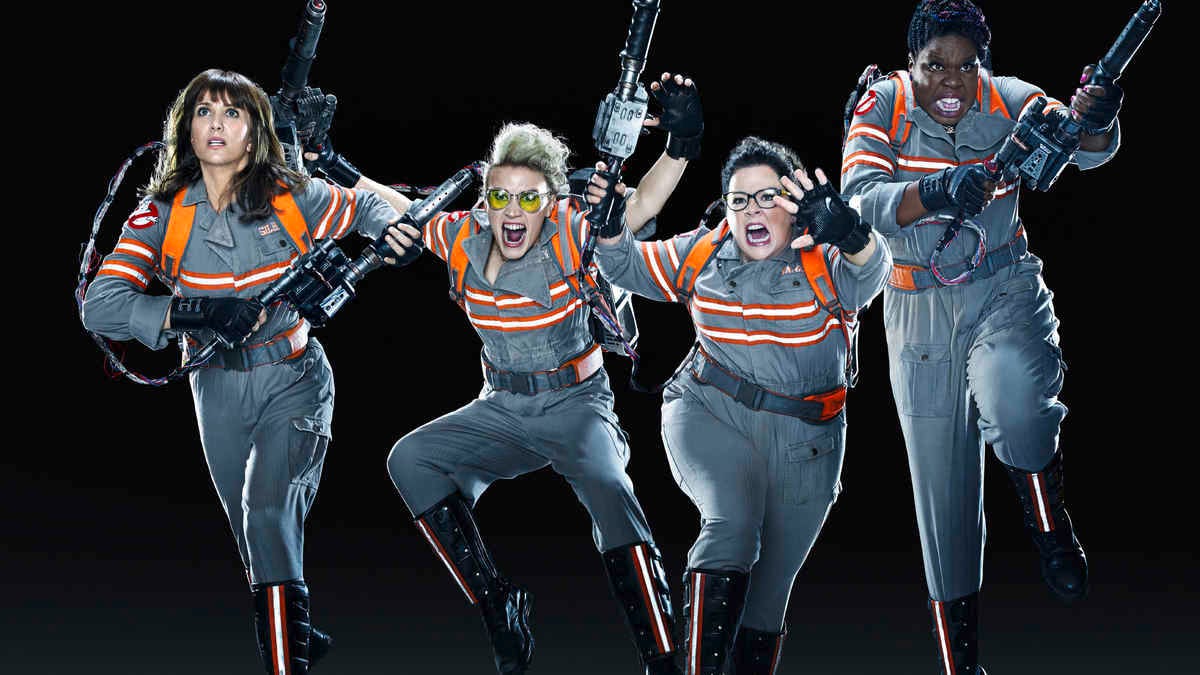
The 2016 remake of Ghostbusters cast the eponymous protagonists as a team of women, and not, as in the original, a team of men. Its trailer polarized the internet, became among the top ten most disliked videos on YouTube, and that before the movie came out. And why not have women ghost busters? To the contrary, they wield hoovers, which only behooves their sex as armament, am I right? I kid, I kid, and yet: if the successful Kurdish army can consist of Kalashnikov slinging young women, then obviously they can handle ghosts, to say nothing of driving tanks, piloting jet-fighters or drones.
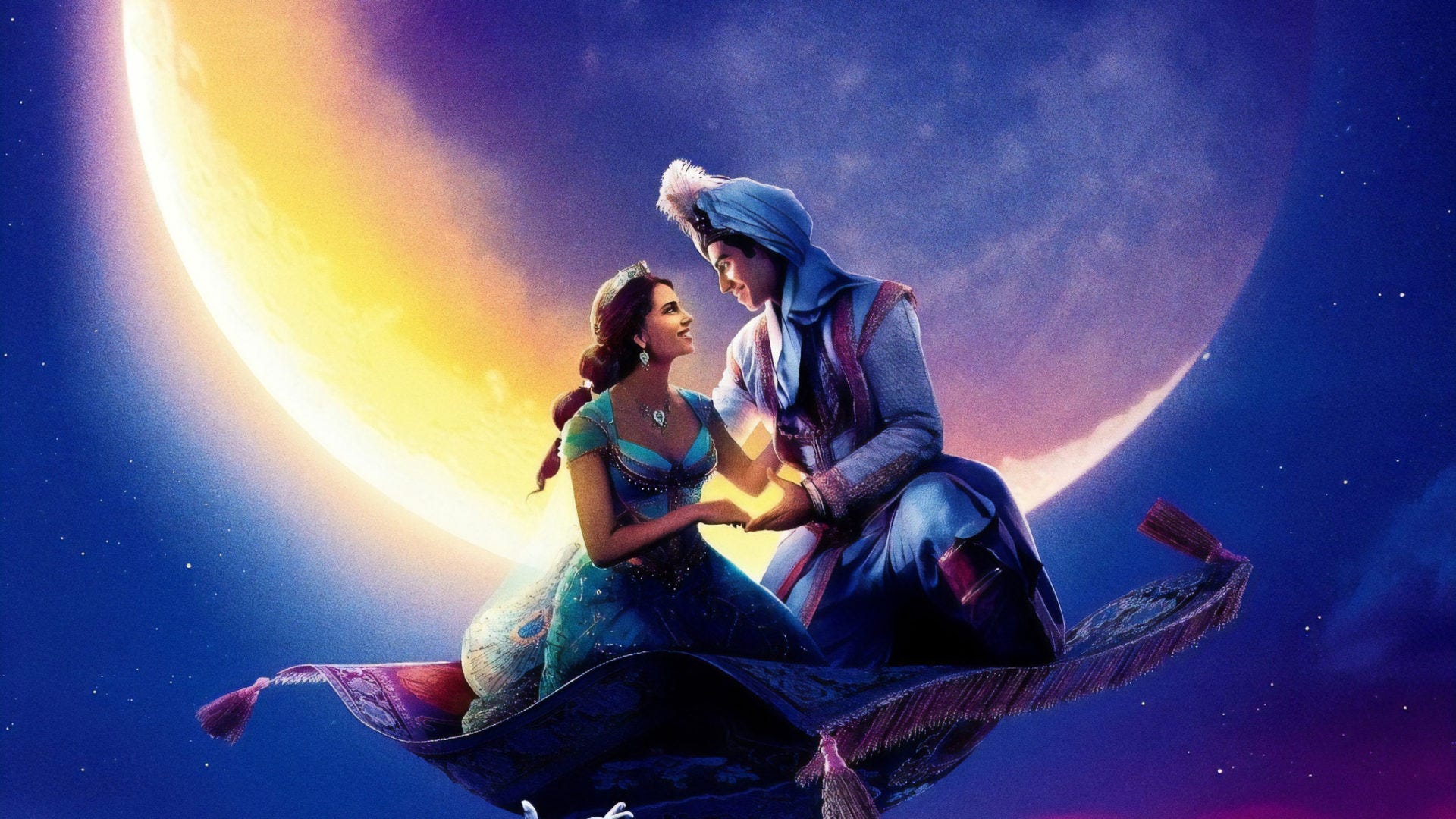
I find it slightly humorous that the Disney 2019 remake of Aladdin evoked criticism over its representation of the ‘Middle East,’ given that in the source material (or the source of the source, as it was a remake of the 1994 animated film), in the One Thousand and One Nights’ Aladdin story, the action takes place in ‘China,’ the names, sultans and viziers notwithstanding. This is of course beside the point; the 1994 film, anyway, begins with the song ‘Arabian Nights’. Nevertheless, it presents itself as a fairy tale and the objection that is it ‘unspecific’ is therefore misguided, and the objection that it misrepresents the culture is —and I’ve seen both objections made by the same person— is contradictory. Either it pretends to depict a certain society (and does it well or not) or it doesn’t. It’s easy to perceive that the beef some take with the movie is that white authors made a story about non-white characters, which they wouldn’t allow. Still one can imagine that had they made him Alastair and set the story in the Scottish highlands, it would not satisfy them either.
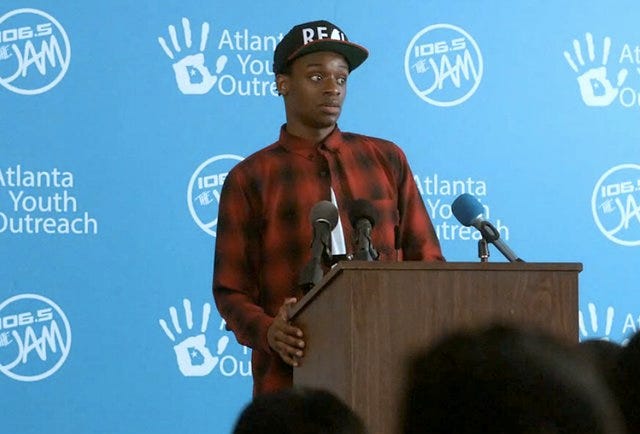
Donald Glover’s Atlanta is a TV series whose entire cast is black. On the fifth episode of its first season there’s a cameo of Justin Bieber —if we could call that— played by Austin Crute. I’d say the TV series is a sui generis, but if pressed to label it I’d say it’s an episodic surrealist urban fantasy set in an imagined Atlanta, Georgia, where this casting decision is not a claim about a Justin Bieber (being black) but a provocation to consider issues of race and representation.

The 2017 DreamWorks produced live-action movie based on Mamoru Oshii’s manga Ghost in the Shell cast Scarlett Johansson as Major Kusanagi, and received much heat for its ‘whitewashing.’ As Oshii himself agreed, this criticism was a misplaced. Major Kusanagi is Japanese like a Mitsubishi car is Japanese, for she is not human but a robot. Take a look at the way that the Japanese like depicting human beings and you’ll see plenty of colorful wide eyed creatures. The whitewashing accusation, beside being wrong that Kusanagi should be/ look Japanese, makes a claim that is tone deaf to what the work is about —already apparent in its title— namely, exploring the the relationship between mind and body.
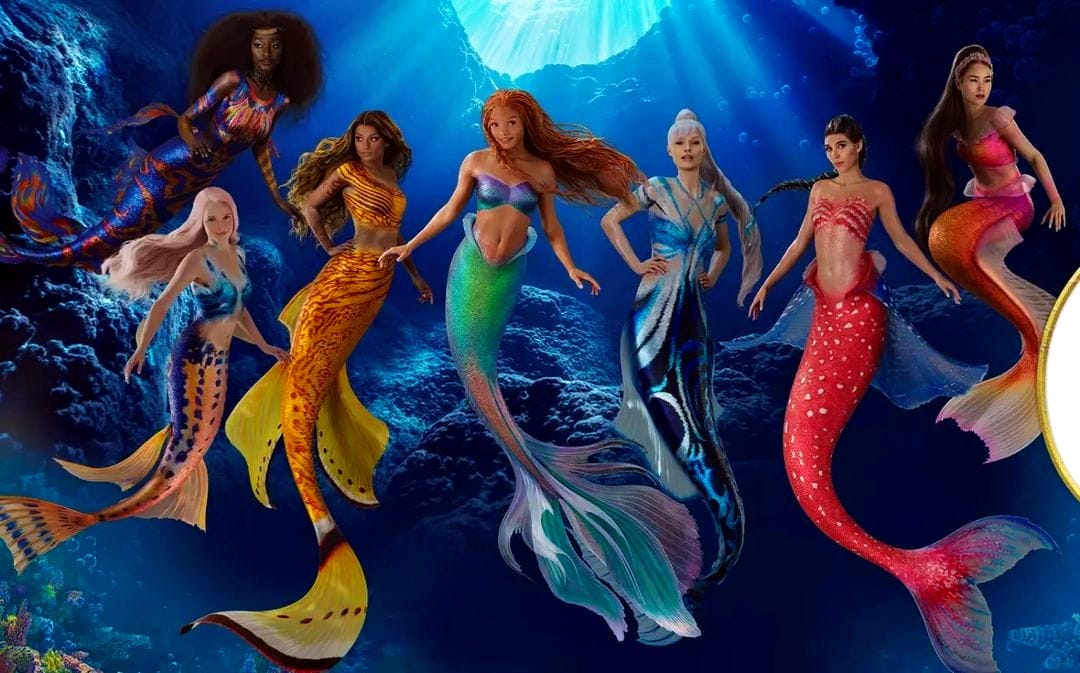
The Disney 2023 remake of The Little Mermaid is an interesting example. The casting of Halle Bailey as Ariel, the eponymous little mermaid, who was white on the 1989 Disney animation, drew a discussion on biology. Subterrestrial and submarine creatures, as well as, apparently, humans who have evolved under overcast conditions, living away from the sun, tend to be bright, if anything, and not dark. Yet it is ludicrous to discuss what skin tone the human half of a merperson should be when it’s not even clear if it’s a fish or a mammal. Ludicrous but understandable: with any work of fiction we accept a few lies as a premise and expect the rest to be congruent with our understanding of the world. In this 2023 The Little Mermaid’s case there’s a complete acceptance of the merpeople as fantastical creatures: Ariel’s father is white, her adoptive mother is black, and her six sisters encompass the gamut of human races, if you will. It’s fantasy, silly. Still, of course, it was all going downhill already with the 1989 movie, where Ariel was given seashells to cover her mammalian glands. Apparently long before the conquistador ships impinged upon their marine kingdoms, a divine revelation had already gave them a visit and turned them into Christian prudes!!
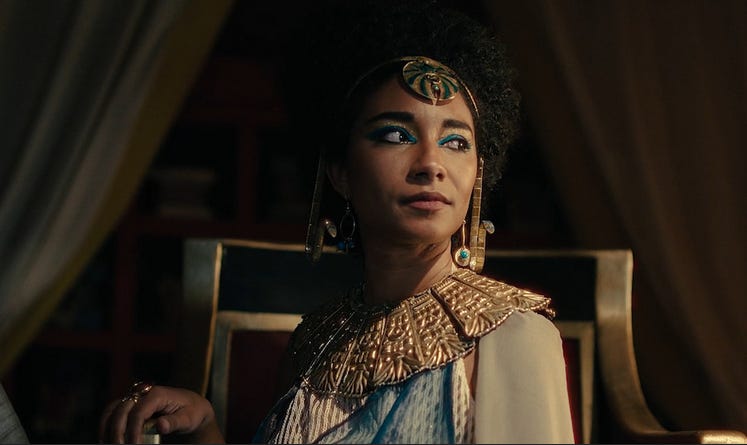
Netflix’s series African Queens‘s second season is about the famed Cleopatra VII, who was cast by the ‘ethnically English/ Jamaican’ actress Adele James. To the degree that she is recognized as black (by viewers and producers) it was a sorry choice and seemed not so innocent. Discovering now that there’s a whole Wikipedia page on Cleopatra ethnicity and that the idea she was black goes back a few decades if not a century, what I had to comment feels frivolous. And nevertheless.
Ancient Egyptians were indeed African, but only as African as all Americans are Americans. Africa is the most ethnically diverse continent on Earth, but if we squint our eyes and pretend that all the populations native to the subsaharan continent are of a single ‘black race’, it’s one to which the North African Egyptians did not belong to, clear also from their artistic depictions of themselves & neighbours. Still, all of this is beside the point, since though Cleopatra was native to Egypt, her ancestors were not. Though Egypt had had indeed black, Nubian, Pharaohs, Cleopatra herself was of a Hellenistic dynasty first installed over the Kingdom by Alexander the Great. Like her name she was essentially Greek and that was the language she spoke growing up and the official language of the court and regime. Thanks to this, as an aside, we have the trilingual Rosetta Stone, a stele from Cleopatra’s great grandfather Ptolemy V’s rule, written in Ancient Egyptian hieroglyphs, the Ancient Egyptian Demotic script, and in Greek, found again by Napoleon’s invading forces and instrumental in deciphering the hieroglyphs.
I haven’t watched the Netflix piece, but it seems like a missed opportunity to tackle issues of culture, ethnicity and indeed colonialism during Cleopatra’s reign. The casting choice, as well as the treatises where the idea that Cleopatra was black was first voiced, seem like what you might call an ideological fantasy. Fine to entertain yourself with, but no so cogent before the audience of others.
If you wanna be properly woke, do so intensely: Spiderman is a fat Vietnamese immigrant single mom, Mary Jane is her unfortunately hereto love interest, Reptile is a trans man trying to continue his biology post-doc business-as-usual via home-office, ha-ha, what? No, my webcam is broken. Yes, STILL! Yes, I did set the permission. No, I WILL NOT USE CHROME, while facing questions of identity and struggling with parthenogenesis; Octopus is a woman on a cruel crusade against the consumers of a certain Japanese art inspired past time; Rhino is just a big guy in a rhino costume, it’s pointless to meddle with perfection, perhaps he is addicted to anabolic steroids to give him a sympathetic tragic side; Kingpin is a South-African megalomaniac that like all big businesses before him thinks he could take advantage of the little megalomaniac politician, until the tables are turned — at the end Vietnamese Spiderman saves Kingpin, because justice, even though he did not deserve it. Maybe saves in the sense of catching him before his escape to South America.
Of course, medieval nobility and its courts had spoken a different language than the people, but you get it. Nonetheless, as an aside, Elizabeth I seems to have been able to speak with all her subjects, and beyond.
I myself watched the movie at home, having therefore the privilege to stop in the middle and question the use of my time. I recalled a permanent marking I had seen on a toilet stall that claimed ‘boyhood is overrated!!’ and found something better to do. Keep on spreading propaganda around loos, it works!
A polarly opposite example is that of the Matrix trilogy. The actor who played the oracle on the first Matrix movie had died before they filmed its sequels. Did they remove the oracle from the sequels? No. They got a new actor and gave her a line of dialog to excuse the change. Personally I think they could have done away even with that, given the illusory nature of the fictional Matrix.
Whether those American comedies were any good, whether it was fair to not let women be actors, are different questions.
The expressiveness of deviations from the norm is a general phenomenon.
Facial expressions, for example, are deviations of a person’s facial features from their relaxed state. Still, because every face is perceived as a member of a category, namely faces, and is thereby interpreted, faces with extreme features, such as the grumpy cat’s or the resting bitch face, would be perceived as expressive when no expression was intended.
This sort of recourse to the group to interpret the intentions of the individual takes place when discussing modesty, e.g. the proper height of a neckline or a skirt’s hemline. To flirt is to (implicitly) express interest in intimacy with another person. Since people are dressed in public and naked when intimate, showing skin, being on the way from the former to the latter, is flirtatious. Like the grumpy cat’s face, a skirt that is fashioned shorter than customary is therefore perceived as expressive, namely, being flirtatious, when it might be merely a skirt of a certain length.
I long wondered what this kind of modesty had to do with the more basic one, i.e. lack of pride and arrogance. I think it’s this: flirting is inherently pretentious. One seeks to transform a relationship of one kind to another, thereby expressing the belief to merit such a relationship. I’m not content with being a mere colleague, customer, friend, second cousin, plumber, I want more.